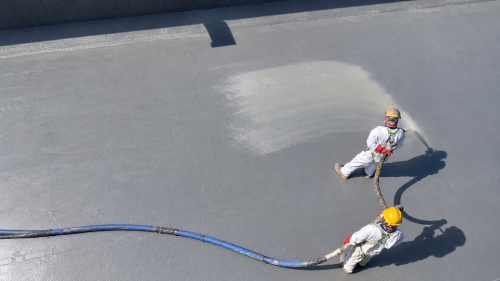
Water rarely announces itself when it starts damaging a structure. A hairline crack in a roof slab, a poorly sealed joint, or a patch of porous concrete can let moisture creep in, corrode reinforcement, and shorten the life of an asset long before the damage is visible. Polyurea waterproofing is one of the technologies used to prevent this, forming a continuous protective membrane over roofs, floors, tanks, and other exposed surfaces. This guide explains what polyurea is, how it works, where it is used, how it compares with traditional systems, and what to consider before specifying it for a project in Saudi Arabia.
What Is Polyurea Waterproofing?
Polyurea is an elastomeric polymer formed when an isocyanate component reacts with an amine-based resin blend. Applied as a liquid, it cures into a continuous, flexible film. In waterproofing, that film works as a membrane or coating that keeps water away from the substrate beneath, whether it is concrete, steel, or another prepared surface.
Polyurea is a family of materials rather than a single product. A polyurea coating designed for a roof deck is not necessarily formulated like one intended for a chemical-exposed industrial floor. Hardness, elongation, UV stability, and chemical resistance differ between systems, which is why technical data sheets matter more than general labels.
Many systems are spray-applied polyurea, where two components are heated, mixed at the gun, and sprayed onto the surface. Hand-applied and hybrid polyurethane-polyurea products also exist, each with its own handling and curing characteristics.
How Does Polyurea Waterproofing Work?
A polyurea waterproofing system works by forming a bonded, seamless barrier over the substrate. Its quality depends as much on what happens before and during application as on the material itself. The process generally follows four stages:
- Inspection and surface preparation. The substrate is checked for cracks, contamination, laitance, and moisture, then cleaned and mechanically prepared, often by shot blasting or grinding. Defects are repaired.
- Priming. Where the manufacturer requires it, a primer is applied to improve adhesion and seal the pores of concrete.
- Application. Plural-component equipment heats, mixes, and sprays the material to the specified thickness, with joints, penetrations, and upstands detailed carefully.
- Curing and inspection. The membrane cures, then is checked for thickness, continuity, adhesion, and visible defects before service or topcoating.
Cure times, recoat windows, and application conditions vary by product, so installers should follow the manufacturer’s data sheet and project specification rather than assuming typical values.
What Are the Main Benefits of Polyurea Waterproofing?
These advantages are commonly associated with polyurea systems, but they depend on the formulation and the installation. No single product delivers every benefit in every condition.
- Rapid curing: Many formulations cure quickly, which can reduce downtime on roofs and industrial floors that must return to service.
- Seamless protection: Spray application can produce a continuous membrane with fewer joints and laps, reducing potential leak paths.
- Flexibility: Elastomeric formulations can accommodate some substrate movement and hairline cracking, within the manufacturer’s stated limits.
- Adhesion: When the surface is properly prepared and primed, polyurea can bond well to concrete and other substrates.
- Abrasion resistance: Some systems cope well with foot traffic, vehicles, and equipment, which suits industrial settings.
- Durability: With the right specification, correct installation, and maintenance, polyurea can offer long-term protection, though service life varies with exposure.
These strengths explain why polyurea is often considered for demanding projects, but each should be confirmed against the product data sheet and actual site conditions.
Where Is Polyurea Waterproofing Used?
Because formulations differ, polyurea appears across a wide range of projects. Typical applications include:
- Roofs and exposed concrete surfaces: flat roofs, podiums, and terraces, where roof waterproofing must cope with sun and thermal movement.
- Foundations and selected below-grade structures: basement walls and similar elements, where a suitable system is specified.
- Industrial floors and facilities: warehouses, workshops, and processing areas where industrial waterproofing solutions must withstand abrasion, impact, or spills.
- Water containment structures and tanks: only where the system is approved for that use, especially where drinking water or chemicals are involved.
- Other infrastructure and commercial projects: parking decks, bridge decks, culverts, and plant rooms.
Product selection must match the substrate, exposure, and intended use. A system that performs well on a roof deck may be wrong for a tank lining, and approvals should be confirmed rather than assumed.
Is Polyurea Waterproofing Suitable for Saudi Arabia’s Climate?
Surfaces in the Eastern Province face intense heat, strong sunlight, coastal humidity, and large daily temperature swings. These conditions test any waterproofing membrane, from substrate temperature during application to long-term UV exposure.
Suitability depends on the specific formulation. Aromatic polyurea systems, for example, are commonly protected with a UV-stable topcoat because sunlight can cause them to weather and change color, while aliphatic formulations are designed for better UV stability. The right approach depends on the product and the manufacturer’s specifications.
Installation conditions matter just as much. Hot substrates, surface moisture, and dew point can affect adhesion and finish, so application windows and moisture testing need careful planning. When evaluating waterproofing solutions in Saudi Arabia, no polyurea product should be assumed suitable for every application without checking temperature limits, topcoat needs, and exposure guidance.
Leave a Reply